~/guide/chapters/05-storage-backup $ cat README.md
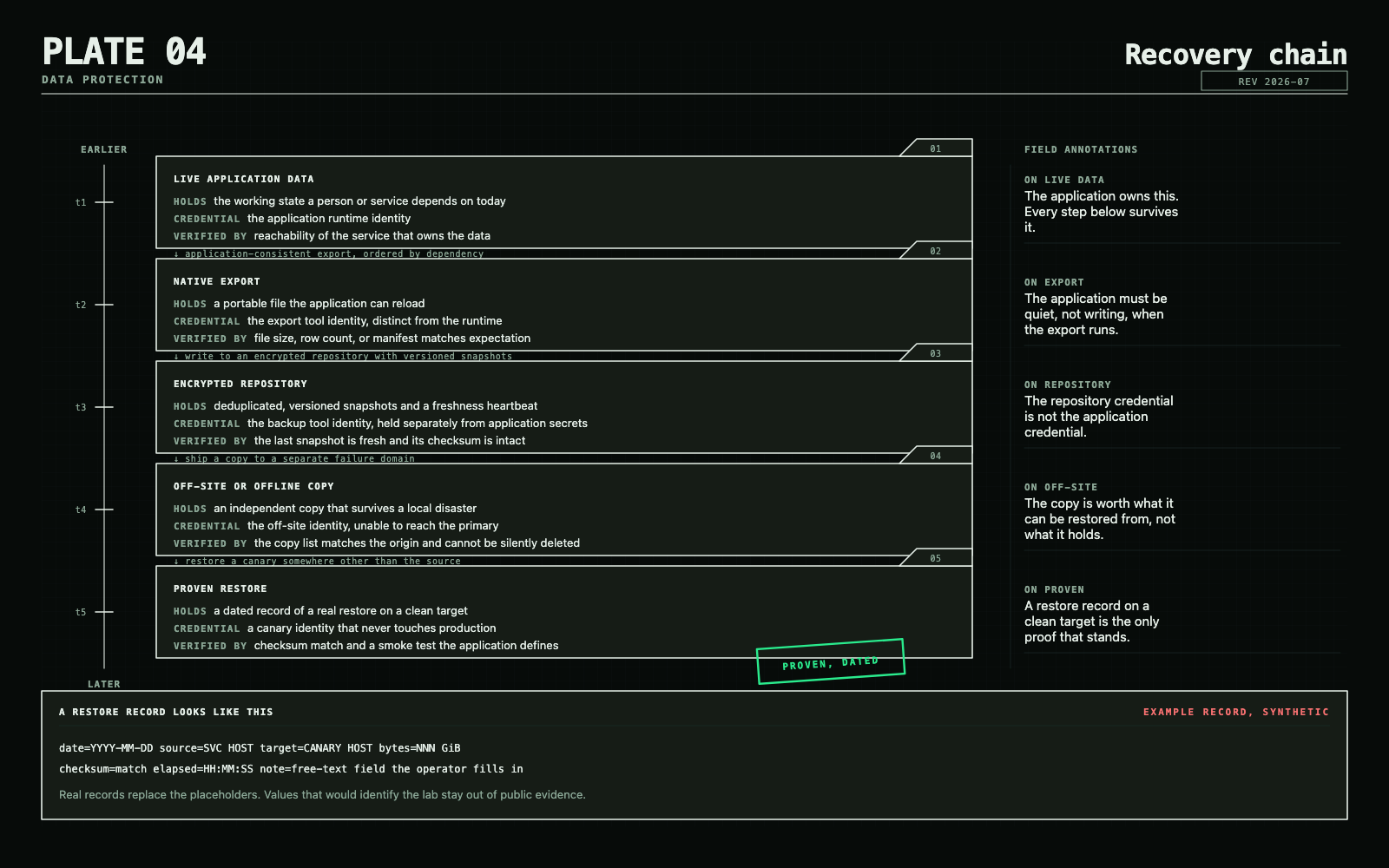
Protect storage and prove recovery
Storage keeps bytes available. Backup makes independent, recoverable copies. They are related systems, not synonyms.
Storage defaults
TrueNAS Community Edition is the default dedicated NAS when you want a supported OpenZFS appliance. The old FreeNAS name is obsolete, and TrueNAS CORE is a maintenance path rather than the greenfield recommendation.
OpenZFS provides checksums, scrubs, snapshots, compression, and replication. Unraid’s classic parity array trades ZFS end-to-end integrity and self-healing for flexible mixed-drive expansion. Its ZFS pools retain ZFS behavior, but do not offer that same classic-array expansion model. OpenMediaVault is the lighter Debian-based NAS. Synology is the polished commercial appliance choice.
Once data matters, separate the storage failure domain from the experimentation host. A starter all-in-one box is fine; a permanent single point of failure is a decision, not an accident.
Build a recovery chain

Target 3-2-1-1-0: three copies, two media or failure domains, one off-site, one offline or immutable, and zero unverified errors.
- Create an application-consistent database export or supported snapshot.
- Capture an encrypted repository backup.
- Copy it to an independent off-site or offline destination.
- Monitor freshness and failures.
- Restore a canary on a schedule.
- Rehearse full disaster recovery periodically.
Proxmox Backup Server is the default for Proxmox guests. Kopia is the default general endpoint/file backup when policies and central management help. Restic is the simpler CLI-first alternative. Borg remains excellent for Unix-to-Unix repositories, but confirm the stable-version guidance before adopting a major new generation.
Avoid comforting mistakes
- RAID is availability, not backup.
- A ZFS snapshot is rollback, not an independent copy.
- Replication can faithfully copy deletion, corruption, or compromise.
- Syncthing and rclone move data; they are not backups by themselves.
- A green backup job is not a restore.
- Encryption keys and recovery configuration belong in the recovery plan.
Field note: The turning point in my own lab was treating restore proof as telemetry. Backup freshness, database-export ordering, and a recurring canary restore tell me more than a successful scheduler exit code.
Primary references
Leave with
A recovery chain and a dated restore-test record.
Done when: A restore has worked somewhere other than the source.