~/guide/chapters/03-platform $ cat README.md
Choose the platform
Use the least complex platform that satisfies the goal.
The default decision
One Linux host plus Docker Compose
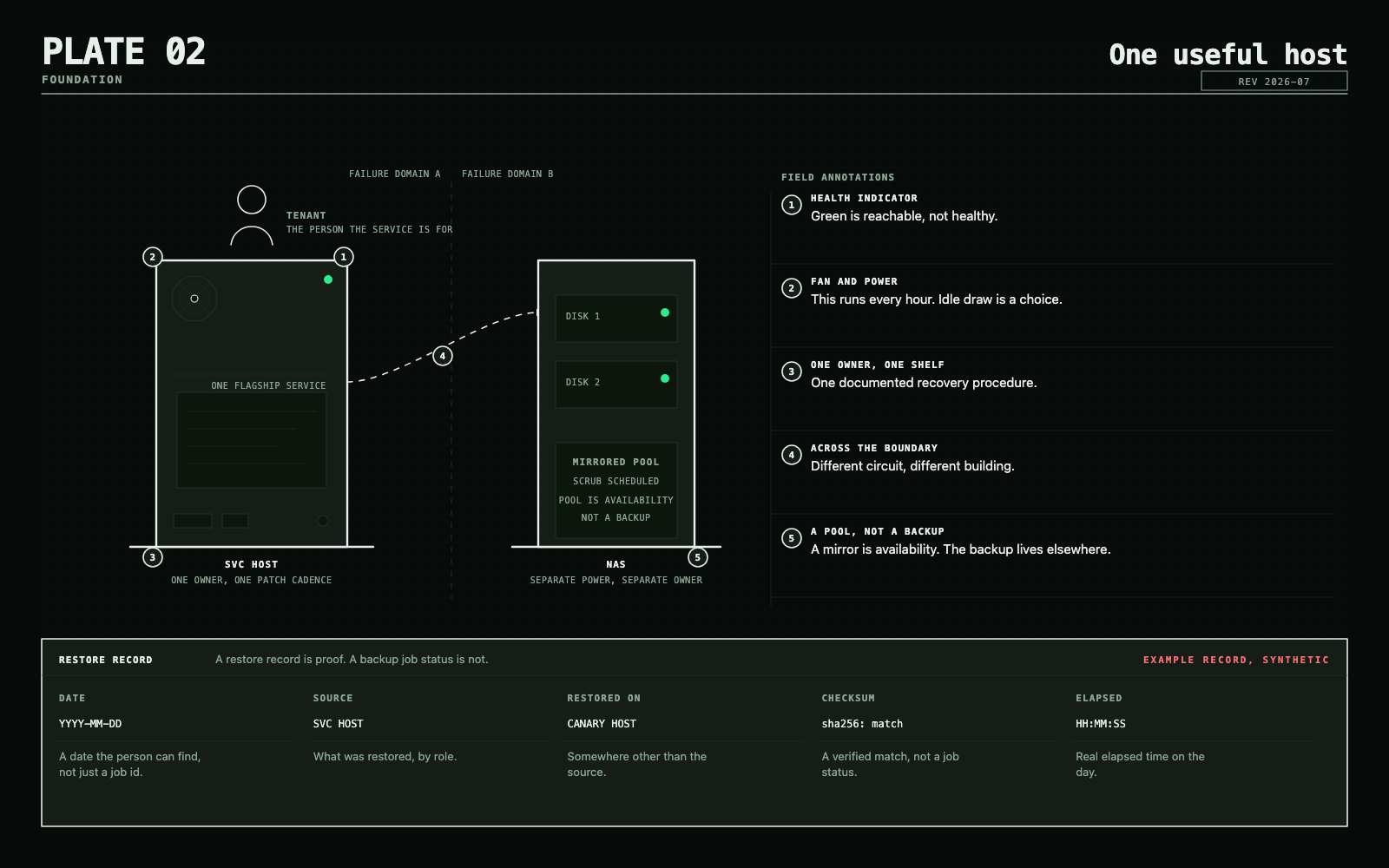
Start here for a small service collection. Debian or Ubuntu LTS, Docker Engine,
and current docker compose are understandable, portable, and well documented.
Keep Compose files in Git and persistent data outside the repository.
Do not begin new instructions with the legacy standalone docker-compose v1
binary. Docker keeps it only for backward compatibility.
Proxmox VE
Choose Proxmox when you need multiple operating systems, stronger workload isolation, virtual networks, PCIe/GPU passthrough, VM lifecycle management, clustering, or native integration with Proxmox Backup Server.
A maintainable pattern is one or more Debian VMs running Compose. Use LXC when you understand its shared-kernel security and device-mapping tradeoffs, not just because it is lighter.
Kubernetes
Kubernetes is justified when the learning objective is Kubernetes, workloads need rescheduling across nodes, or declarative multi-node operations solve a real problem. K3s is the default homelab distribution: conformant, compact, and packaged with sensible components.
Kubernetes does not remove storage, networking, backup, or upgrade work. It makes those concerns explicit and distributed.
Talos Linux is the advanced immutable-node path for operators who want an API-managed Kubernetes operating system. It is not a general-purpose Linux server.
Meaningful alternatives
- Incus: system containers and VMs for low-overhead, VM-like Linux environments. It complements rather than replaces application containers.
- XCP-ng with Xen Orchestra: a strong VM-first appliance and integrated backup experience for people who prefer the Xen ecosystem.
- Unraid applications: convenient when the storage appliance and application host are intentionally combined and the operator accepts the shared failure domain.
Keep roles clear
The hypervisor owns virtual machines. The guest OS owns its updates. Compose or Kubernetes owns application deployment. The storage system owns data integrity. The backup system owns recoverable copies. Blurring all five into one interface may feel convenient until recovery day.
Primary references
- Docker Compose production guidance
- Proxmox VE documentation
- K3s documentation
- Talos Linux documentation
- Incus documentation
Next: Design networking and access.
Leave with
A short platform decision record.
Done when: The added layer solves a requirement you actually have.